
Watonwan County Criminal Docket Searches
For a Watonwan criminal case, the statewide starting point is Minnesota Court Records Online, or MCRO. Pick Case Number if you have a file number. Name, Citation Number, and Attorney searches are there too. Results open a Case Details page, where the running record of case activity goes by its formal name, the Register of Actions. When you know the county, choose Watonwan under court locations, and use the Criminal category to keep a broad search under control.
One limit matters a great deal. A pending criminal case will not appear in a defendant-name search before conviction, and that bar also covers matters dismissed or continued for dismissal while still pending. In those situations, search by case number, citation number, attorney name, or attorney bar number instead. Type the identifiers exactly right: case numbers contain letters and hyphens but never spaces.
- Open MCRO Case Search and select the method that matches the available case information.
- Choose Watonwan County and the Criminal category when a narrower search is useful.
- Enter the full case number, citation number, or the most exact available name information, then select Find.
- Open View Case Details and read Case Information, Charges, Case Events, Hearings, Dispositions, and Financial Information.
- Use Document Search, the courthouse terminal, or Court Administration when the needed public document is not available in the result.
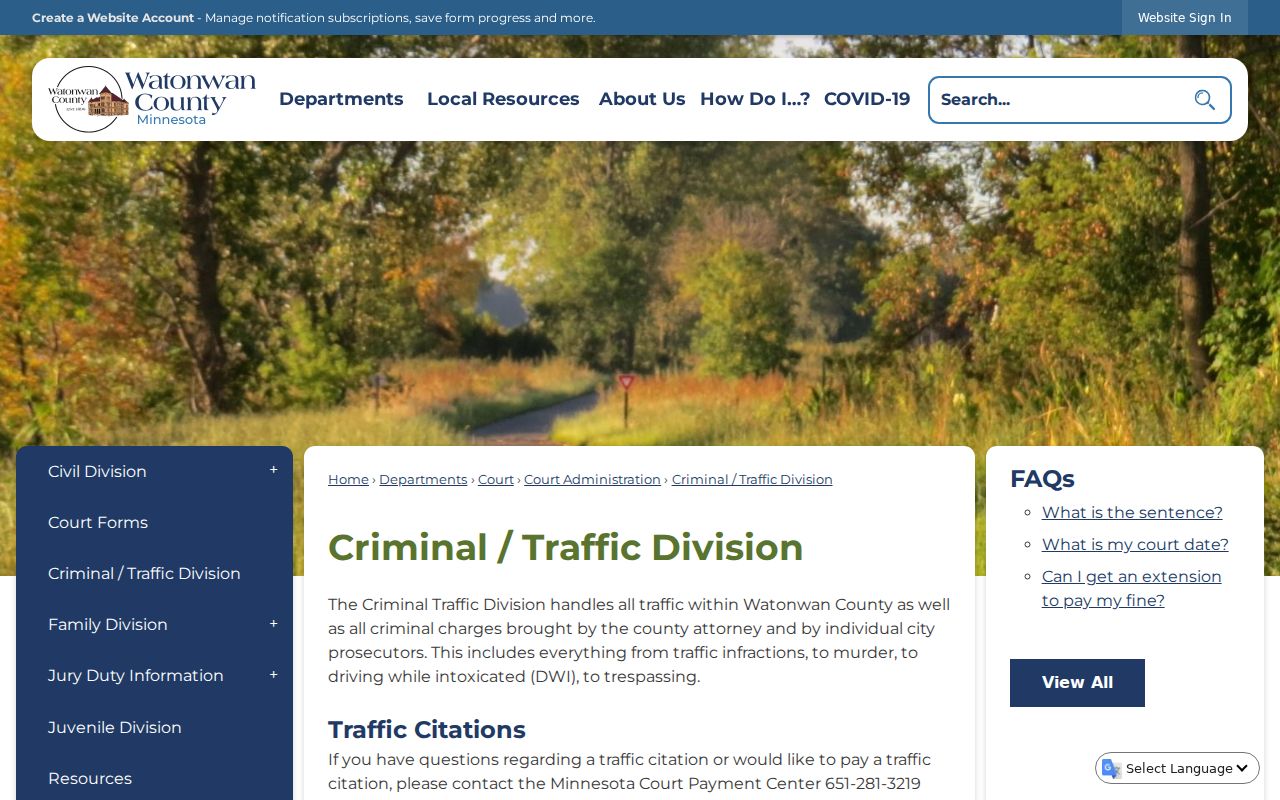
The Watonwan County Criminal / Traffic Division covers the local division that handles charges brought by the county attorney and city prosecutors.
City prosecutors sometimes file an ordinance charge. Even so, the court record lands in the county district-court system, not in a separate city docket.
Watonwan 83-CR Criminal Docket Search
Every Watonwan criminal file number starts with the county code, 83. The usual pattern is 83-CR-YY-NNN: 83 for the county, CR marking a criminal case, then the year and filing sequence. The official calendar uses the same style. Searching by number is usually the fastest MCRO route. It sidesteps both close names and the pending-case name limitation.
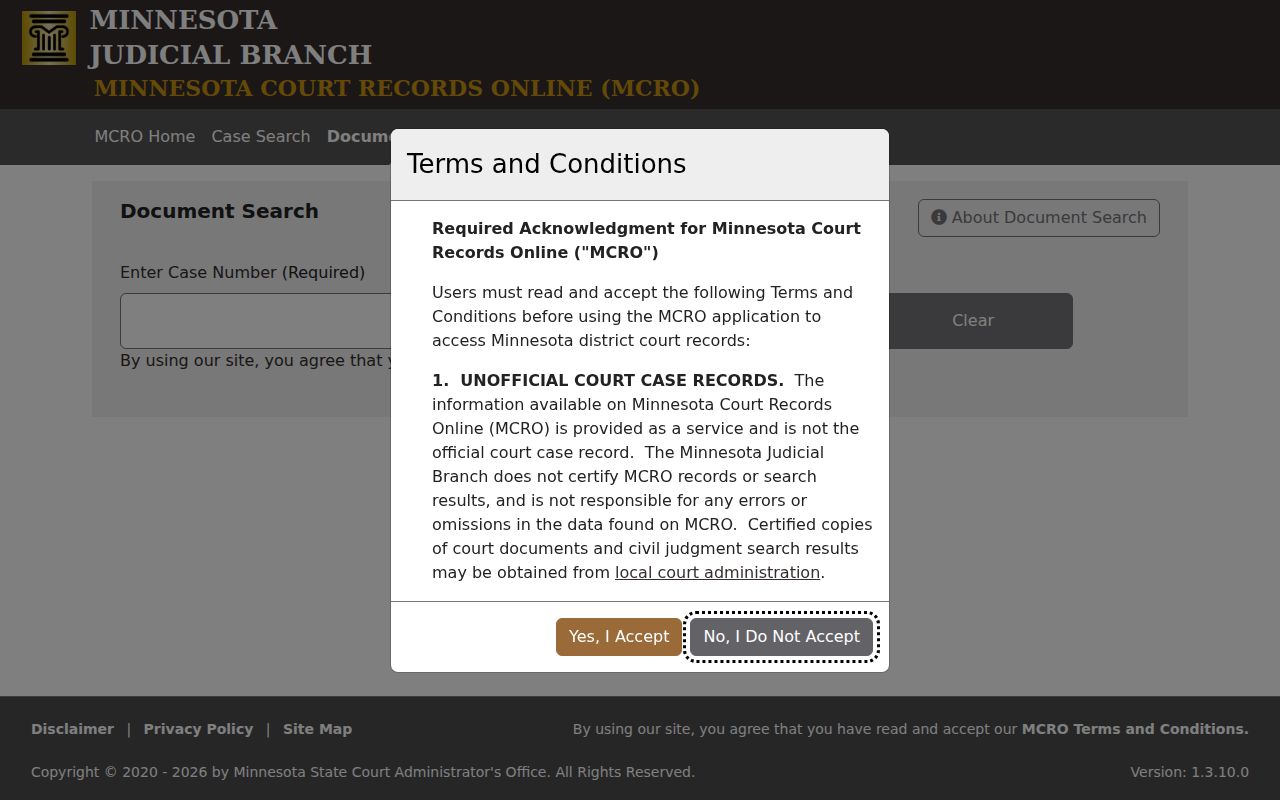
MCRO also has a separate Document Search for finding public documents tied to a case number. Access there does not equal the full case file, though. A downloaded MCRO document is free when available. But it is not a certified copy, and older or restricted material may be missing. The official MCRO Document Search screen shows why holding onto the complete file number pays off. That pays off when a specific public filing must be located.
Take the case number from a notice, citation, or Register of Actions result. A partial number copied off a calendar line is not enough.
Criminal Dockets: What They Show
A Watonwan criminal Register of Actions opens with Case Information. That block holds the case number, case type, filing date, court location, judicial officer, status, citation number, flags, and related cases. The party area may list roles and attorneys. Charges, interim conditions, bond or bail activity, active warrants, case events, hearings, dispositions, and financial entries each sit in separate areas, so never read a single line as the whole result.
Case Events display newest first. An entry may carry an event description, a document index number, and a document-view control when a public document is online. The Hearings area covers both future and prior settings. Read its date, time, location, judicial officer, hearing type, and connection role alongside the events rather than in isolation.
| Case number | Local criminal format such as 83-CR-YY-NNN, with no spaces. |
|---|---|
| Charges | Current accusations and, where shown, amended-charge history. |
| Case Events | Reverse-chronological filings and court activity, sometimes with a public document link. |
| Hearings | Past or future date, time, location, judicial officer, hearing type, and party connection. |
| Disposition | Plea, criminal outcome, and sentencing information when entered. |
Watonwan Criminal Docket Name Gap
A missing name result does not mean the case was never filed. Minnesota's MCRO rules restrict pending criminal name searches. The service does not spell out every gap. So check the filing number, citation, attorney name, or bar number first. Then apply the county filter, the right case category, and exact spelling before switching tactics.
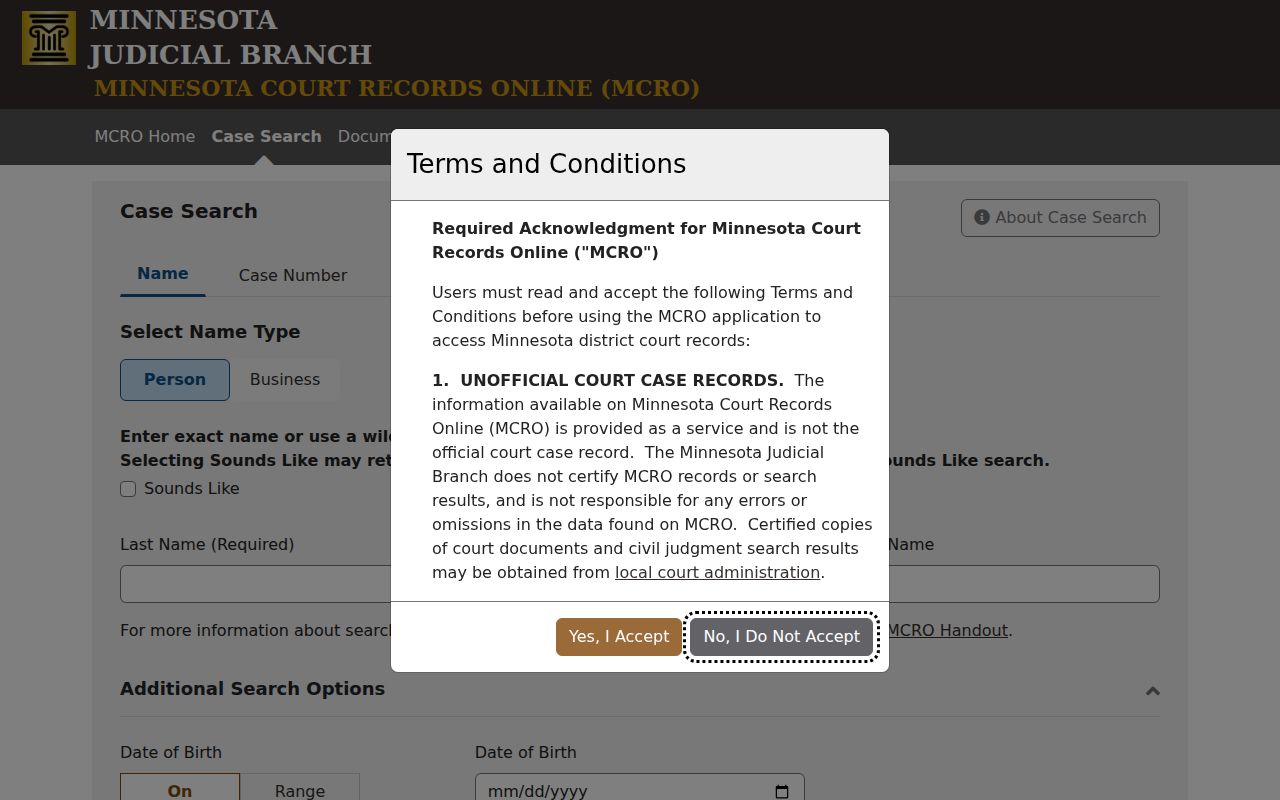
MCRO has a Sounds Like option for similar names. It also allows a wildcard after two characters, though the two tools cannot be combined. A wrong date of birth or filing date can knock out the correct match just as easily. When a search returns too many entries, narrow by Watonwan location, filing date, or an exact identifier. Do that instead of guessing at a name. The MCRO Case Search page is the official public entry point for these field choices.
If a specific case still cannot be confirmed remotely, call Court Administration. Staff can explain the public access channel, though they cannot give legal advice.
Criminal Case Stages on the Docket
Pay attention to the order of entries. A complaint, citation, tab charge, or other charging event opens the file. A first appearance or arraignment then shows up in the hearing row. Any interim conditions appear there as well. Omnibus hearings take up pretrial legal or probable-cause issues in felony cases. A pre-trial or scheduling conference is just case management. A plea hearing is only a setting; the later plea or disposition entry records what actually resulted.
Docket flow: Filing → Arraignment → Pretrial → Plea or Trial → Disposition → Sentencing
Sentencing can be a separate event from the recorded plea or conviction. Probation-violation, review, or intermediate-disposition hearings may keep appearing after the original outcome. Ordinary Minnesota eFile and eServe (eFS) is not the public docket, and criminal charging documents do not move through its ordinary filing route. If an appeal is filed, the district-court record may show notice or record transmission, but the appellate case itself proceeds through the Minnesota Court of Appeals.
Watonwan Criminal Docket Calendar Terms
Watonwan's public calendar labels the type of court event, not the outcome. Expect entries like Omnibus Hearing, Pre-trial, Plea Hearing, Sentencing, Probation Violation Hearing, Scheduling Conference, and Intermediate Disposition Hearing. Each label marks what was scheduled. A hearing can also sit in the historical Register of Actions after the court has moved the date. The name alone tells you nothing about what happened.
- Omnibus hearing
- A felony pretrial setting for probable-cause and legal issues.
- Pre-trial
- A hearing before trial used for preparation, motions, or managing issues.
- Disposition
- The recorded outcome, such as a conviction or dismissal, rather than merely a scheduled appearance.
- Bond or bail activity
- The separate history of bond amount and status, including a posted bond where shown.
So read the whole hearing row alongside the newest event. That habit keeps a scheduled plea or sentencing date from being mistaken for an entered result in the Watonwan docket.
Watonwan County Criminal Docket Courts
Criminal cases filed in the county start at the Minnesota District Court, Watonwan County District Court. That court holds original jurisdiction. It sits inside Minnesota's unified district-court system. Felony and gross-misdemeanor files are therefore not parked in a separate Watonwan municipal docket. Petty-misdemeanor, traffic, and qualifying ordinance citations show up in the county court information system too. A payable citation may sit without any future hearing. It can wait until an appearance or payment is due.
Watonwan County Court Administration keeps the local criminal records. The official Watonwan District Court page confirms the county district court handles criminal matters. It does so along with its other case categories. The issuing city can appear in charge or party information. That does not change where the court Register of Actions lives.
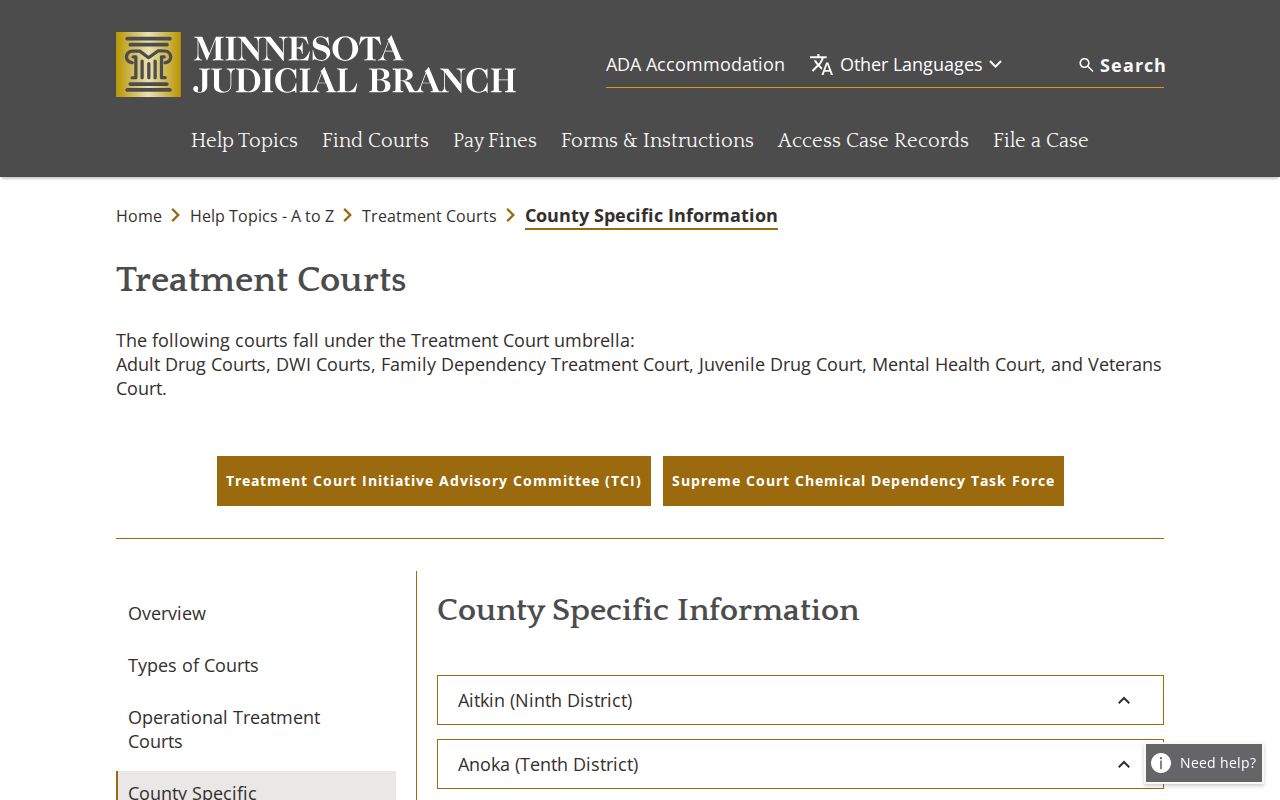
Minnesota's county-specific treatment-court information lists the Southern Prairie Treatment Court as a multi-county adult drug and family-dependency program. The program includes Watonwan.
Joining that program does not open a separate public county docket. The underlying district-court case and its access rules still control the record.
Watonwan Criminal Docket Bond Activity
Bond or bail activity is not the charge. In MCRO it records the amount and status history for a case. A posted bond is one example. Interim Conditions is its own field, covering obligations while the case is pending. Active-warrant flags need context as well. A party-level flag can belong to another case entirely. The warrant section and a case-level flag point to a warrant in the file you are viewing.
A safe reading order is Case Information, Charges, Interim Conditions, Bond/Bail Activity, Warrants, Case Events, Hearings, and Dispositions. A current event beats any label read alone. Remember what the public Register of Actions is. It is a record of court activity, not a transcript or a stand-in for the actual order.
Access Rules for Criminal Dockets
Minnesota Rule of Public Access Rule 2 opens with a presumption of public access. Other rules, statutes, and court orders impose limits. Juvenile, CHIPS, domestic-abuse, harassment, civil-commitment, sealed, expunged, and confidential materials may be unavailable remotely. Some may be withheld entirely. Street addresses, comment fields, identifiers, and protected documents can be limited too. An online absence does not prove no court record exists.
Start with MCRO. Then check the Watonwan weekly calendar for a hearing. When public data or documents are not online, use the MNPAC public-access terminal at the Watonwan courthouse. Court Administration can pull locally stored paper or older off-site material at its counter. Reach them by phone at 507-621-6005 or by mail at P.O. Box 518, St. James, MN 56081. Plain copies are free. A certified criminal instrument is listed at $14. A certified disposition comes from Court Administration rather than MCRO.
Access route: Rule 7 provides the procedure to request record access or correction when the public view is incomplete or denied.
Rule 9 provides an appeal route from a denial of access. A sealed or confidential record requires the applicable access form and a judge’s decision before a copy request proceeds.
For a court date, compare the latest MCRO hearing entry with the local calendar. Contact Court Administration if they do not match. Certified records and current balance questions go to the local office.
Watonwan Criminal Docket Terminal Access
MNPAC, Minnesota Public Access Courthouse, is the public terminal layer inside district courthouses. It offers the most complete electronic access to public district-court records. That includes material never posted to the public internet. It matters most for D-16 juvenile delinquency, CHIPS, harassment or domestic-abuse records, civil-commitment material, and hidden fields. The governing rule permits courthouse access to those.
At the counter, bring the case number, party or caption, document title, and an approximate date. Ask whether the record you need is electronic, on site, off site, archived, confidential, or sealed. Court staff may share public information and explain process. They cannot give legal advice. Need a paper file or certified record? Call Court Administration before making a special trip.